
Fader Talk education series: Create your Mixing Eq cheat sheet
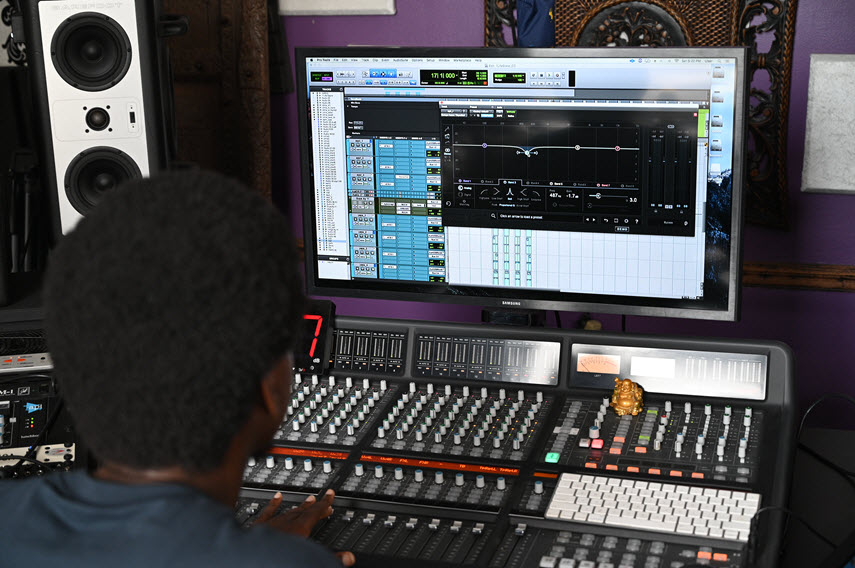
Welcome to this Fader Talk education series where we’ll go over some few tips in hopes to help you improve your mixing skills.
First, start to think of your mix as comprising two zones for instrument placement: the Front (near) and the Back (far).
When mixing, determine whether each instrument should reside in the Front, creating a close-to-listener effect, or in the Back, giving a distant impression.
When applying the two zones concept to mixing drums in particularly it will help you get a 3D sound and serve as a mental eq cheat sheet.
The best way to get a feel for the proximity of elements in your mix is to listen with your eyes closed.
That's because open eyes often dominate our perceptions and actually reduce our hearing sensitivity.
This is one of the big tips on how to eq vocals professionally.
Below are some basic differentiations I've notice between the Front and Back of my mixes:
Front Instruments:
- Typically possess higher volume levels compared to those positioned in the back.
- Contain more high-frequency content than their rear counterparts.
- Often exhibit reduced reverb, as heavily reverberated elements tend to recede further into the background.
Instruments in the Back:
- Generally, have lower volume levels compared to instruments up front.
- less high-frequency content in comparison with front-positioned instruments.
- Tend to incorporate more reverb than front instruments.
By consistently deciding whether a sound belongs in the Front or Back, your mixes will instantly achieve
will instantly achieve greater depth and clarity.
What is EQ? In mixing EQ serves as a shaping tool, similar to how a sculptor utilizes a chisel or how individuals use makeup to alter the contour and look of their faces.
Similarly, we employ EQ to shape and refine the presentation of our instruments.
Occasionally, we're not just reshaping the form of a sound; rather, we're finding the bad frequencies within a specific instrument or sound and removing them.
For instance, an instrument may have a lot of bass or little treble. In such cases, EQ is used to address these discrepancies.
Hence, EQ serves two main purposes: sculpting and refining the presentation of our instruments.
To manage the balance among instruments, two primary EQ approaches are utilized: Cutting EQ and Boosting EQ.
Your main goal with EQ is to establish a pleasing balance of sounds among instruments.
To achieve this, we will use the Front and Back Paradigm.
By determining which sounds occupy the Front and which reside in the Back of your mix, you'll naturally become more precise in your EQ adjustments.
In the upcoming sections on how to eq a mix, I'll illustrate the specific techniques for employing cutting and boosting EQ to achieve a well-balanced Front-to-Back mix.
However, before delving into that, it's essential to grasp the concept of the Fab-4 EQ Zones.
Fab-4 EQ Zones involves setting forth the four primary sound regions we manipulate within our song.
Understanding these zones helps identify which instruments are competing for specific frequency ranges, enabling us to make EQ adjustments to tighten up the frequency balance within each zone.
The 4 Zones:
Lows: 0Hz – 200Hz, housing bass, kick power, and snare body. This zone primarily accommodates bass/kick power, with other elements aggressively attenuated within this range.
Mids: 200Hz – 1kHz, containing the core and body of most instruments. It's crucial to judiciously select dominant instruments within this range to avoid a cluttered mix.
High Mids: 1kHz – 7kHz, where instrument forwardness and presence reside. This range is particularly sensitive to boosts and cuts around 2 - 3kHz.
Highs: 7kHz – 20kHz, dominated by cymbals and hi-hats, contributing to the sizzle, liveliness, and high-definition quality of instruments. If the mix sounds overly sibilant or airy, attention should be given to this range.
When employing EQ cutting and boosting techniques, our focus will be on making broad adjustments within these 4 frequency zones to achieve a well-defined Front-to-Back Mix.
Starting with a broad strokes approach is simpler and more instinctive because mixing involves a gradual process of sculpting and refinement.
It's easier to begin broadly and then narrow down to specifics.
If, during the broad strokes phase, you fail to achieve 80% of your desired mix, then the issue lies in the broad strokes, and fine-tuned adjustments won't fix the problem.
During broad strokes mixing, we rely on WIDE EQ Cuts and EQ Boosts with a Q value of 1 or less.
By employing wide EQ boosts/cuts, we can determine the most impactful adjustments by navigating through each of the 4 frequency zones and selecting the one that enhances our sound the most.
Adopting a broad strokes approach will immediately enhance the clarity and definition of your mixes.
The 300 Rule
Among the challenges producers face, a common frustration is encountering a murky or indistinct low end in their mixes.
This issue arises when instruments within the 20Hz to 400Hz frequency range of the mix clash, leading to what can be termed a conflict catastrophe.
This frequency range, 20Hz to 400Hz, poses the greatest challenge for mastering due to our limited ability to discern details within it.
To overcome this inherent weakness in our low-end hearing, we can abide by a simple guideline—the Rule of 300.
This rule dictates that any instrument that isn't bass, kick, or snare should be high-pass filtered at 300Hz or higher, with higher cutoff points being preferable for the mix.
By sticking to this rule, you eliminate the primary causes of a muddy mix, as the issue arises when the 20Hz to 400Hz range is overwhelmed by competing instruments.
When professional mixers speak of balance, they envision a balance scale, where one end carries something heavy, and the other end holds something light.
Similar to the balance scale, you must be discerning in which instruments carry heavy frequency content and which ones carry lighter frequency content.
Balance, in this context, denotes a pleasing listening experience, but for mixers, achieving balance entails making deliberate choices about which instruments exhibit frequency density and which ones adopt a lighter frequency profile within a given frequency zone.
By sticking to this rule, your mixes will immediately elevate to the top echelons of quality.
When you think about how to eq vocals professionally or how to eq electric guitars in mixsituations that are crowded with instruments within the same frequency range you’ll be able to deploy your new eq cheat sheet.
In future blogs we’ll go over how to mix drums, vocal eq tips, vocal eq settings, and vocal eq and compression.
If you're looking for online mixing services or mix and master online using Eastroom Suites for your next music project will provide you with the highest quality polish. Check out the link to hear some before and afters!
Before and Afters